No antlers
Both sexes lack antlers. Hydropotes inermis is the only extant true deer with this fully antlerless form, a trait reflected in its scientific name, ?œunarmed.??/p>
International Vampire Deer Association
A living emblem of wetlands and woodland edge: Hydropotes inermis, the Vampire Deer. IVDA exists to make this remarkable animal known, understood, and loved around the world.

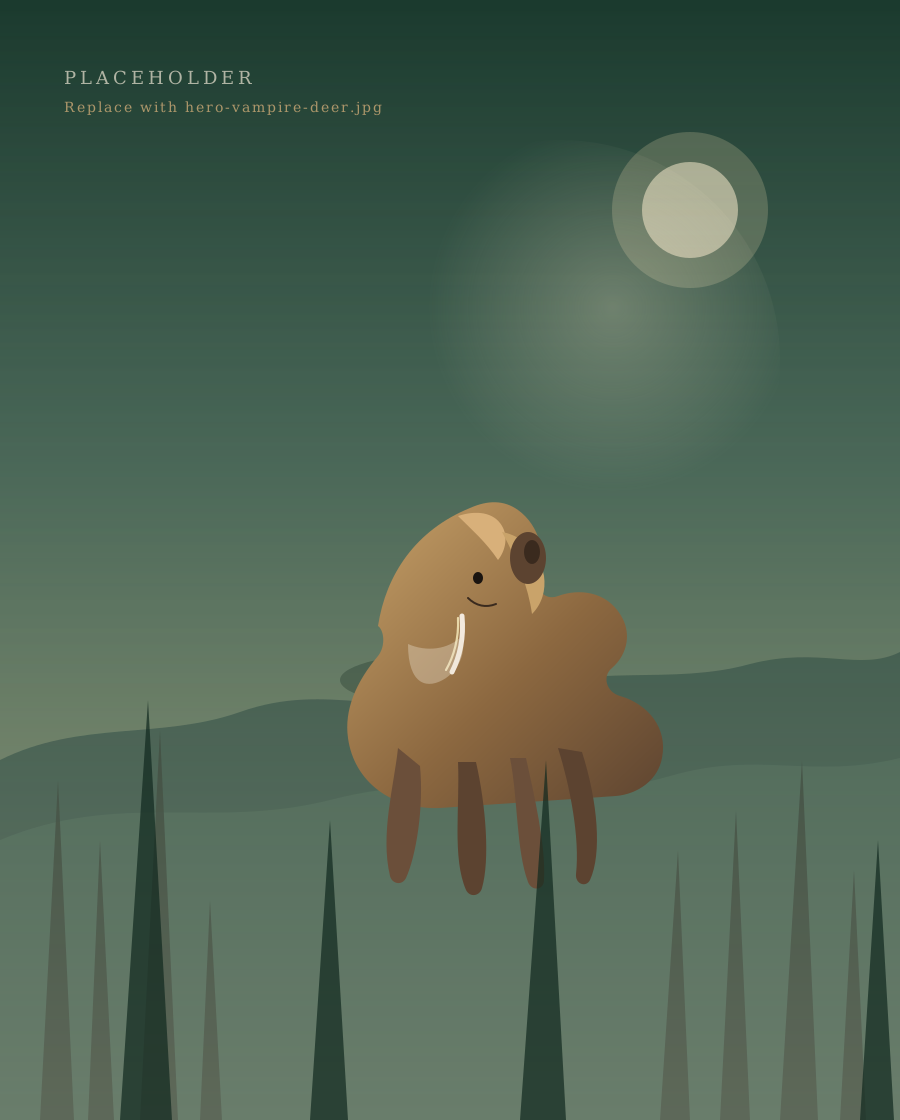
Tap the Vampire Deer to reveal the IVDA emblem

The characteristic call will play here in a future update.
A species apart
Among living true deer, the Vampire Deer is a study in graceful contradiction: antlerless, tusked, solitary, and unusually prolific. It is small enough to vanish in reeds, and distinctive enough to become a global symbol.
Both sexes lack antlers. Hydropotes inermis is the only extant true deer with this fully antlerless form, a trait reflected in its scientific name, ?œunarmed.??/p>
Males grow long upper canines used in ritual combat, not in feeding. The teeth sit loosely in the sockets and can be drawn back while the animal browses.
Native to river valleys, reedbeds, and coastal wetlands of China and the Korean Peninsula, the Vampire Deer is an accomplished swimmer and a master of cover.
The famous canines
The Vampire Deer is named for a pair of downward-curving upper canines. In adult males they commonly reach about 5.5 cm and can grow to 8 cm. Females usually carry only minute canines.
These teeth are ancestral among deer and were largely replaced by antlers in other living species. In the Vampire Deer they remain the principal weapon of territorial dispute. Rivals assess one another, then may stab or tear at the head, shoulders, and back. Fights are seldom fatal, but torn ears and long scars are common among bucks.
IVDA treats this anatomy with care: striking, memorable, and entirely herbivorous. The Vampire Deer is not a predator. Its ?œfangs??are a language of rank, territory, and evolutionary history.
Biology and behavior
Adults typically stand 42??5 cm at the shoulder, measure 77??00 cm in body length, and weigh 9??4 kg. The coat is golden brown in summer and greyer in winter. Rounded ears, a almost hidden tail, and a tapered face complete a silhouette that is immediately recognizable once you know it.
Outside the rut, Vampire Deer are largely solitary. Males hold territories, marked with scent from glands unique among the deer family. The alarm call is a barking note; an injured animal may give a piercing wail, the sound that will later accompany the emblem on this site.
Reproduction is exceptional. After a gestation of roughly 170??10 days, a female may bear from one to seven young, most often two to five. That fertility is part of why local numbers can recover quickly where habitat and protection allow.
Range
The native heartland is eastern China and the Korean Peninsula. The species favors reeds, river islands, swamps, grasslands, and the edges of cultivated land. Introduced and expanding populations now extend the map, and with it the need for careful public understanding.
Fragmented wetland strongholds, including coastal Jiangsu and riverine landscapes of the lower Yangtze basin. The Chinese population (H. i. inermis) is of high conservation concern.
The Korean population (H. i. argyropus) is widespread in South Korea, known locally as gorani, and also occurs in protected landscapes of the north.
A free-living introduced population, descended from early collections, is established in parts of eastern England, especially wetland and farmland mosaics.
Recent records show northward presence, including Primorsky Krai in Russia. Range change makes accurate, shared knowledge more important than ever.
Learn with us
IVDA gathers trustworthy science and translates it into clear public knowledge. These starting points will grow into a living library.
Why IVDA exists
The International Vampire Deer Association promotes and builds awareness of the Vampire Deer, develops a recognizable global brand around the animal, and provides accurate, professional knowledge to the public.
We believe this species deserves a clear name in culture as well as in science. ?œVampire Deer??is memorable; Hydropotes inermis is precise. Together they can carry conservation, education, and delight without confusion or caricature.